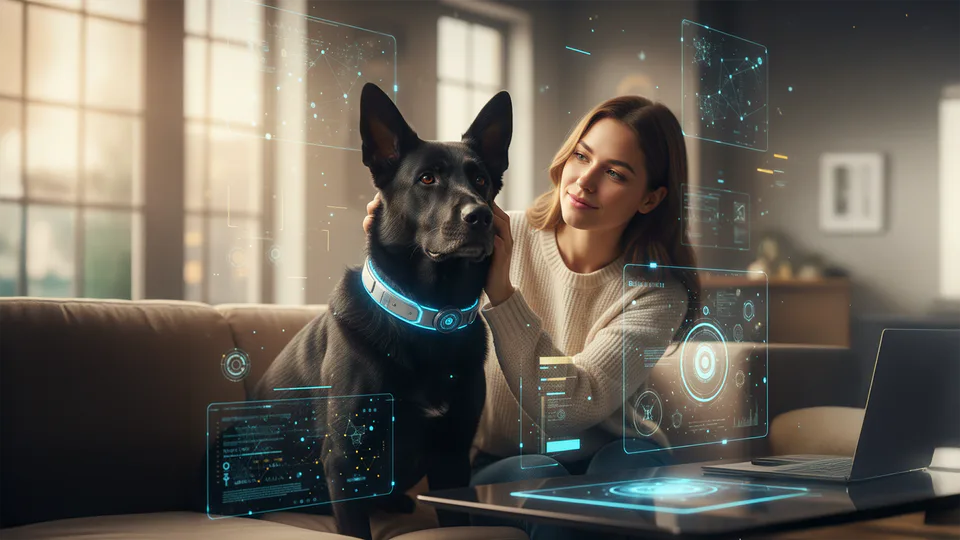
If wolves became dogs by learning to read us, the next leap in canine intelligence may come from learning to live with our technology.
🤖 When Dogs Meet AI
Artificial intelligence isn’t just changing how we work — it’s reshaping how we train.
Smart collars track sleep, stress, and heart rate. AI-powered cameras recognise barks, movements, and even facial expressions. Some systems can now alert you if your dog is anxious, lonely, or in distress before you’ve even noticed.
But this isn’t about replacing instinct with code — it’s about understanding it.
AI gives us new windows into the canine mind: micro-patterns of body language, subtle stress indicators, and the feedback loops that shape behaviour. When used thoughtfully, it helps us see what our dogs have been telling us all along.
🎮 Enrichment for the Digital Dog
Modern dogs face a strange paradox: they live safer, more comfortable lives than ever — yet boredom and frustration are now among their biggest welfare risks.
Enter smart enrichment.
Interactive feeders, scent puzzles, and voice-reactive toys aren’t gimmicks; they’re neural workouts. A five-minute puzzle session can activate the same satisfaction pathways as a full walk.
Even simple tech — an automatic ball launcher or programmable treat dispenser — can be a lifeline for dogs left alone while we juggle work-from-home calls or errands.
Still, no gadget replaces human connection. The magic happens when tech enhances communication, not replaces it. Imagine training apps that learn your dog’s style, or VR simulations that help reactive dogs practise calmness safely. That future is closer than you think.

🌱 The Evolution Continues — In Our Homes
Selective breeding shaped intelligence in the past; selective living shapes it now.
Dogs are adapting to fast-changing human lifestyles: smaller homes, flexible routines, urban noise, and hybrid work schedules.
Some breeds are showing new behavioural trends — greater emotional resilience, faster adaptability, and even stronger social referencing (that instant check-in glance when they’re unsure what to do).
These aren’t random quirks; they’re the modern equivalent of evolution’s quiet notes, playing out in living rooms instead of forests.
💡 The Next Leap: Co-Learning
We used to think training was a one-way street — humans teach, dogs learn. But science now shows it’s a loop.
When we train with empathy, consistency, and curiosity, we rewire too.
Our dogs teach patience, observation, and emotional regulation — lessons even AI can’t simulate.
The future of canine intelligence isn’t about creating dog geniuses.
It’s about building a deeper, data-informed partnership between biology, empathy, and technology.
Dogs won’t just respond to our commands — they’ll help us understand what connection really means in an increasingly digital world.
🧭 Final Thought
Technology may be shaping the way we understand dogs, but it’s our empathy that shapes how they understand us.
Each innovation — from AI-driven training aids to cognitive enrichment games — brings us a step closer to bridging the communication gap that began around ancient campfires.
What’s emerging isn’t just a smarter dog, but a smarter relationship — one built on mutual learning, emotional fluency, and respect.
The future of canine intelligence isn’t about turning dogs into machines that obey faster; it’s about helping them think, choose, and feel with greater confidence in a modern world.
So next time your dog tilts their head at you — remember: you’re not just seeing curiosity.
You’re seeing 30,000 years of co-evolution looking back.
🐾 Coming Next
“Beyond Obedience: Teaching Dogs to Think, Not Just React.”
We’ll explore how cognitive training, emotional literacy, and interactive problem-solving are helping dogs move beyond commands to true understanding — and why that shift might redefine training forever.