There’s a certain kind of afternoon light that never quite repeats itself.
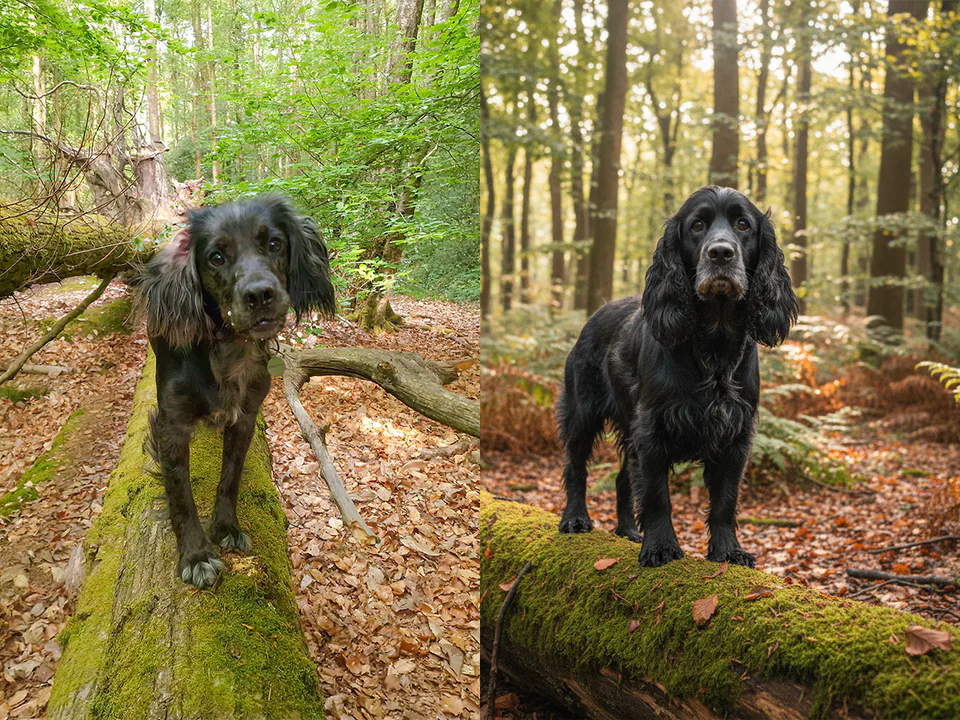
The sort that slants through the kitchen window and catches Dexter’s fur just right — soft, amber, and impossible to fake. I’ve spent whole minutes holding my breath, waiting for that light to sit still long enough for a click.
AI doesn’t wait. It just invents the moment.
Lately, I’ve been thinking a lot about that difference — between seeing and simulating. Artificial intelligence can now conjure a perfect photo in seconds, sharper and more symmetrical than anything I could take on my best day. And yet, every time I test one of those tools, something in me hesitates. Because as good as they are, I can’t feel the heartbeat behind the image.
The Machines That See Everything but Feel Nothing
Don’t get me wrong — AI gets an awful lot right.
It nails composition. It understands balance and tone. It can generate golden light that would make any landscape photographer jealous. I even use it myself sometimes — Google Gemini’s Nano Banana to test lighting ideas, or an AI enhancer to clean up noise from low-light food shots.
But here’s the catch: AI doesn’t notice anything.
It doesn’t wait for steam to curl from a stew or the glint in a dog’s eye before it bolts for the treat jar. It doesn’t sense that tiny flutter of connection that tells you the shot matters.
Photography, for me, has always been about patience — about earning a moment rather than manufacturing one.
What It Misses Most
When I shoot food, the story isn’t just in the colours or textures. It’s in the steam, the crumbs, the little mess that says someone was here.
When I shoot Dexter, it’s in the small tilt of his head that means you’re taking too long, Dad.
AI images are stunning but sterile — like a showroom kitchen where nothing ever burns, or a dog who never moves.
They can’t surprise you. They can’t frustrate you. And maybe most importantly, they can’t make you laugh.

The Human Eye Is Also a Heart
The best photographs have a sort of empathy baked in.
When you’re behind the lens, you’re not just framing a subject — you’re listening to it. You’re reading light, mood, and memory all at once.
That’s why two people can stand in the same place and take entirely different photos: one technical, one tender.
AI has millions of examples of tenderness, but it’s still guessing what it means.
We, on the other hand, can feel it before we even raise the camera.
And maybe that’s the point. Seeing isn’t about pixels or precision. It’s about presence.
Co-Creating, Not Competing
I’m not anti-AI. Far from it.
I use it like I’d use a tripod or a reflector — a clever tool, not a replacement for the craft.
It helps me storyboard product shots, play with concepts, even generate reference lighting before I set up the real thing.
The trick is knowing where to stop.
The photograph ends when the story begins to feel lived-in. That’s the part only a human can add — the breath, the imperfection, the warmth that says someone cared enough to wait.
The Art of Seeing Isn’t Going Anywhere
As I write this, Dexter’s asleep by my feet, tail twitching in a dream. The late-afternoon light is creeping back across the floorboards — that same impossible glow that no algorithm can quite mimic.
I lift the camera, half-smiling, and take the shot.
Maybe one day AI will understand that kind of moment.
But until then, I’ll keep trusting the oldest tool I have — the art of seeing.