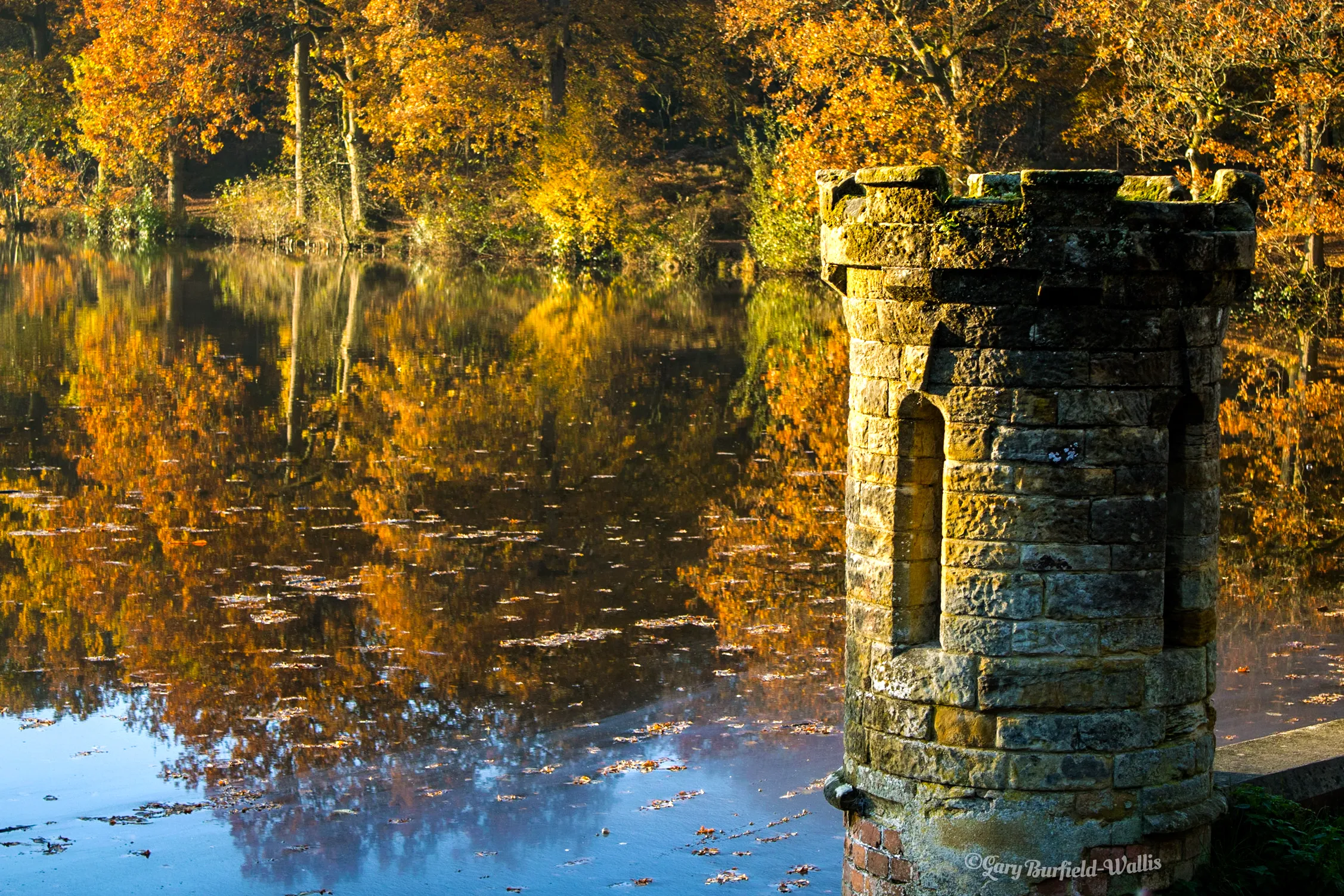
This was not a journey to a famous viewpoint. It was a familiar place, encountered while out walking the dogs, at the point when autumn colour and still water briefly did most of the work.
Familiar places are easy to stop seeing. The route becomes practical: walk, turn, continue. Photography interrupts that habit.
The reflection nearly becomes the subject
Warm trees fill the upper half of the frame and repeat through the water. That repetition gives the photograph its colour and calm, but perfect symmetry would risk becoming decorative and flat.
The stone tower gives the eye somewhere to stop
The tower is heavier, darker and more defined than everything around it. It breaks the reflection, pushes into the foreground and prevents the eye from drifting endlessly across orange and gold.
It also provides scale. Without it, the water and reflected woodland could become almost abstract. With it, the place returns.
The strongest element in a landscape is not always the largest. Sometimes it is the thing that interrupts the pattern.
A photograph found rather than arranged
Nothing in the scene was moved. The useful decisions were about position, timing and frame: where the tower sat, how much reflection remained and whether the brightest colour had somewhere to lead.
That is one reason local photography matters. Repeated visits remove the pressure to force a picture. Most days the place is simply the place. Then the light changes, the water settles and familiarity becomes visible again.