Close-up photography changes scale, but the most interesting change is in the photographer. It forces looking to slow down.
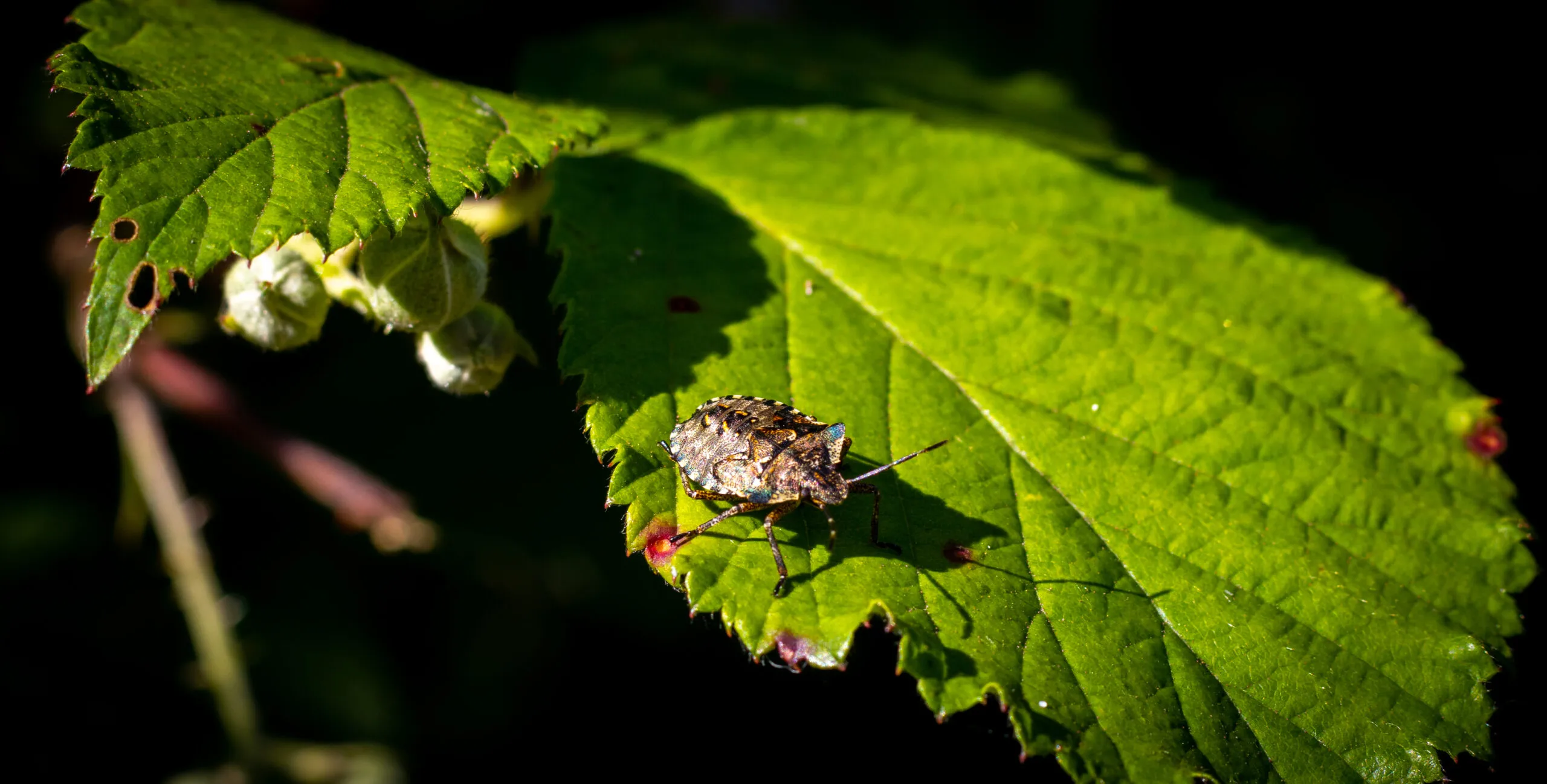
The subject here is a small shield bug resting on a leaf. At walking pace it is almost nothing: a dark mark against green. Inside the frame it gains armour, pattern, legs, shadow and a place within the structure of the leaf.
Begin with the relationship, not the magnification
The insect is small, but the picture is not only an identification record. The broad leaf, damaged edges, strong veins and hard sunlight create the environment. Removing all of that would make the bug larger and the photograph less specific.
Focus becomes a decision about importance
At close distances, very little falls within sharp focus. That limitation can be frustrating, but it also makes the photographer choose. Here the insect needs enough clarity to hold attention while the leaf remains readable as a surface and a place.
More depth of field is not automatically better. The useful amount is the amount that explains the subject without turning every background detail into competition.
Hard light can reveal and destroy
Strong sunlight gives the leaf texture and throws a distinct shadow beneath the insect. It also creates bright areas that can pull the eye away. Changing position by a few centimetres may matter more than changing a setting.
Getting closer is useful only when the closer view tells us something the ordinary view did not.
Do not forget the living subject
Small creatures are not props. Work quickly, avoid handling or trapping the subject for convenience and leave the scene as it was found. A photograph of nature should not require the subject to pay for it.