A starter is a maintained culture rather than a one-off mixture. Consistent equal-weight feeds and observation of its rise are more useful than expecting an exact calendar.
Cook · Recipe
Sourdough Starter
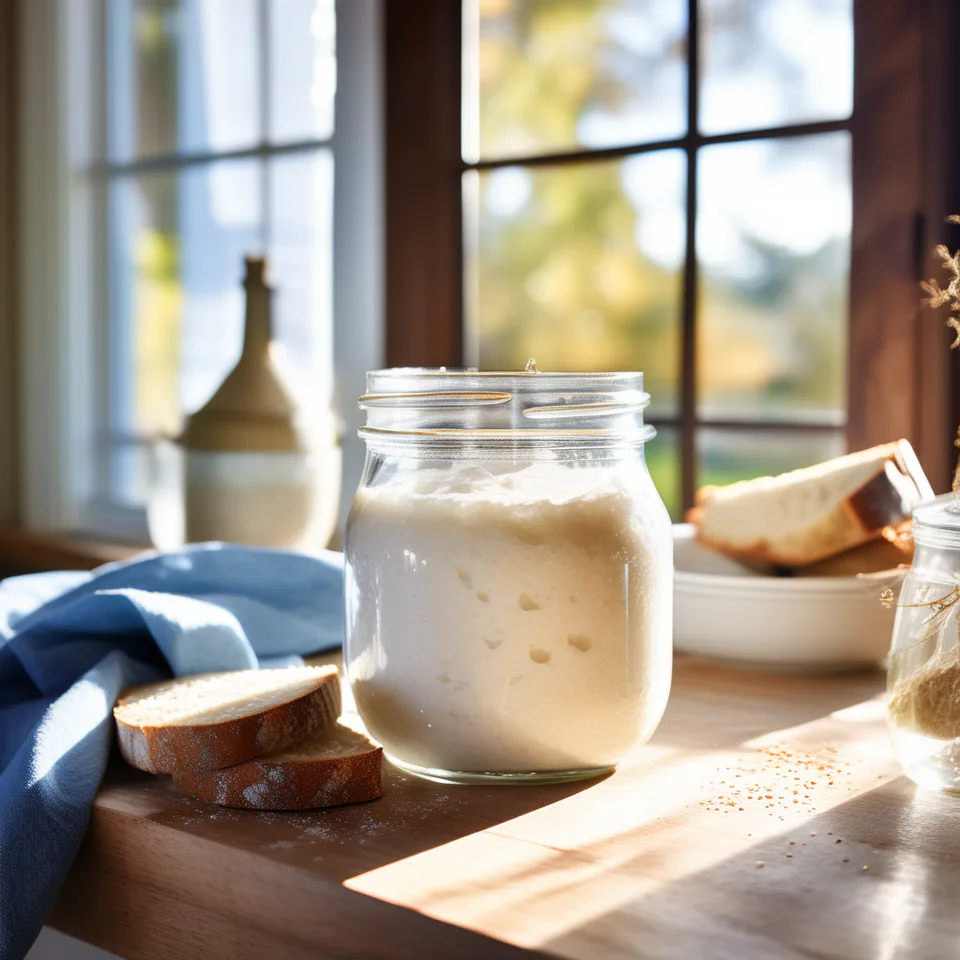
A simple flour-and-water culture built over several days until it bubbles reliably and doubles after feeding.
At a glance
Recipe summary
- Prep
- 20 min
- Rest
- 4 days 23 hr 40 min
- Total
- 5 days
- Serves
- 1 active starter
- Skill
- Easy
What you need
Ingredients
Metric US Ingredient
60 g ½ cup wholemeal wheat or rye flour For the first feed.
60 ml ¼ cup filtered or dechlorinated water For the first feed.
60 g per feed ½ cup per feed unbleached plain flour For subsequent feeds.
60 ml per feed ¼ cup per feed filtered or dechlorinated water For subsequent feeds.
How to make it
Method
- Day 1: Mix 60 g wholegrain flour with 60 ml water in a clean jar until no dry flour remains. Cover loosely and leave at room temperature for 24 hours.
- Days 2 to 4: Discard all but 60 g of the mixture. Add 60 g plain flour and 60 ml water, mix well and cover loosely. Repeat every 24 hours.
- Once the starter begins rising and falling predictably, feed it every 12 hours using the same discard-and-feed routine.
- Days 5 to 7: Continue until the starter is bubbly, smells pleasantly tangy and doubles within about 4 to 6 hours of a feed.
- Use the starter when active and near its peak. Keep back at least 60 g to continue feeding.
- For less frequent baking, refrigerate after feeding and refresh weekly. Bring back to room temperature and feed until reliably active before baking.
Useful notes
Equipment
- Clean glass jar of at least 750 ml
- Digital scales
- Spoon or small spatula
- Loose-fitting lid or clean cloth
- Elastic band or marker for tracking the rise
Substitutions
- Rye flour often encourages early activity, but wholemeal wheat also works.
- Once established, feed with bread flour or plain flour according to preference.
Allergen notes
- Contains wheat and gluten unless maintained entirely with a suitable gluten-free flour system.
- Fermentation does not make standard wheat starter safe for coeliac disease.
Storage
Keep an established starter at room temperature with regular feeds, or refrigerate and feed roughly weekly. Discard any starter showing coloured mould, pink or orange streaks, or a putrid smell.
Tips
- Use equal weights of flour and water for a predictable 100% hydration starter.
- Mark the level immediately after feeding so doubling is easy to judge.
- Warm rooms speed fermentation; cooler rooms slow it down.